

Protecting Your Trees: Understanding Critical Root Zones
Why Critical Root Zones Matter for Your Trees
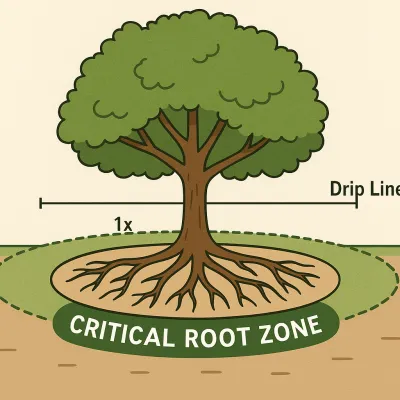
The critical root zone (CRZ) is the circle of soil around a tree’s trunk that you protect during construction or landscaping. In its Root zone mode, our calculator starts at 1 foot of radius for every inch of trunk diameter (DBH), a common minimum in county tree rules. It adds space, up to 1.5 feet per inch, for species that handle root damage poorly and for compacted or clay soil. That stays inside the range arborists use, 0.5 to 1.5 feet per inch (Colorado State University Extension).
Example: a red oak 20 inches across is in the Sensitive group, so its root zone reaches about 30 feet from the trunk in every direction (20 times 1.5). A red maple the same size is in the Tolerant group and needs about 20 feet (20 times 1.0). Not sure of the trunk width? Use our Tree Diameter Calculator. The calculator above also shows the root plate that holds the tree up (about 3 to 6 times the trunk width), and its Arborist method uses the tree’s age and how well it handles root damage (0.5 to 1.5 feet per inch).
The trees on your property do more than just provide shade and beauty. They increase property values, reduce energy costs, and support your local ecosystem. But these valuable assets need proper protection, especially during construction or landscaping projects. That’s where understanding the Critical Root Zone (CRZ) becomes essential.
Everywhere, from historic city streets to suburban neighborhoods, protecting tree roots is vital for maintaining healthy trees that can withstand occasional severe weather.
Strategic tree placement and proper care can significantly enhance your property’s value. As arborists have observed in many communities, well-placed trees provide not just aesthetic benefits but also practical advantages like energy efficiency, privacy, and noise reduction.
Common Native Trees and Their Root Systems
Every native tree species has its own root needs. Here are some common ones:
- Oak Trees: Found across much of the U.S., these majestic trees develop extensive root systems that require large protection zones
- Flowering Dogwoods: These popular yard trees have sensitive root systems that can be easily damaged
- Maples: Red and silver maples handle root cutting fairly well; sugar maples are less tolerant
- Redbuds: These native flowering trees add spring color but need proper root protection
Native trees, including Oaks, Dogwoods, and Redbuds, form the backbone of local ecosystems, providing wildlife habitat and supporting pollinators. In every climate, trees face challenges from harsh weather, pests, and diseases, making professional care essential.
How Construction Impacts Tree Health
Construction activities are a common threat to tree health everywhere. When heavy equipment compacts soil or excavation damages roots, trees can decline slowly over several years. Understanding your tree’s critical root zone helps prevent this costly damage.
Many cities and counties have tree removal permit rules, and they often require tree preservation plans for construction projects. Using our calculator helps ensure compliance with these requirements while protecting your valuable trees.
Common Tree Health Issues
Beyond root damage, trees face several challenges:
- Fungal Growth: Mushrooms growing at the base of trees often indicate underlying health problems. While woodland fungi are natural parts of our ecosystem, some fungi that produce mushrooms can signal internal decay, requiring assessment by licensed tree care professionals.
- Storm Damage: Severe storms can damage trees with compromised root systems
- Soil Compaction: Common in urban areas, compacted soil restricts root growth
- Drought Stress: Even established trees need proper root zone protection during occasional dry spells
Professional Tree Care From Certified Arborists
Finding expert tree care is essential for maintaining healthy trees. Grant Brothers Tree Service, based in Virginia, provides specialized tree services. Our team of certified arborists offers comprehensive care including tree removal, pruning, and emergency response services.
For emergency situations such as storm-damaged trees, professional tree services offer rapid response times, often under one hour, to secure your property and prevent further damage. At Grant Brothers, we often answer within minutes, and a crew is usually on the way within 15 minutes.
Using the Critical Root Zone Calculator
Our Critical Root Zone Calculator is designed specifically with common yard and street trees in mind, from oaks and maples to elms and London planes. By accurately determining the CRZ for your trees, you can:
- Plan construction projects that minimize impact on tree health
- Establish protection zones during landscaping work
- Understand which trees might be at risk during property improvements
- Create long-term tree preservation strategies
- Check how much of the root zone a dig or trench would cut, with the Root loss check
Protecting Your Community’s Tree Canopy
Responsible tree care involves understanding local environmental guidelines. In most communities, being aware of regulations regarding tree removal and trimming is crucial. Professional tree services navigate these laws to ensure your landscaping efforts are both legal and environmentally sound.
By using this calculator and working with qualified arborists, you’re helping preserve your community’s precious tree canopy for future generations.
Contact Grant Brothers Tree Service for a professional assessment of your trees’ health and critical root zones.
Learn more about our emergency tree services for storm-damaged trees.